
Investing in Buildings: First Cost vs. Long-Term Cost
Home / Investing in Buildings: First Cost vs. Long-Term Cost / Investing in Buildings: First Cost vs. Long-Term Cost
Municipal leaders today face constant pressure to deliver high-quality public facilities while operating within tight budgets. Many respond by designing buildings that meet minimum code requirements at the lowest possible upfront cost — a decision that is easy to justify to taxpayers and governing bodies. While those initial savings may look appealing, they are often offset over time by higher operating costs, more frequent maintenance, and the premature replacement of equipment and infrastructure.
By shifting the focus from first cost to total lifecycle value, cities can make smarter investments that deliver better performance, last longer, and provide greater benefit to the community.
Designing to meet the building code is meant to control costs and ensure public dollars are spent responsibly. However, how “code minimum” is achieved deserves closer examination.
Contractors can hit low price points by proposing systems that barely meet requirements, or by substituting less-durable materials. Price is only one component of value and should not be treated as a stand-in for quality, performance, or long-term cost effectiveness.
A framework for better decision-making
Using a structured and transparent framework for decision-making helps municipal teams weigh trade-offs among cost, quality, performance, and the desired community outcomes. One effective tool is a decision matrix, which scores project options across multiple criteria rather than relying on price alone. Key matrix considerations typically include:
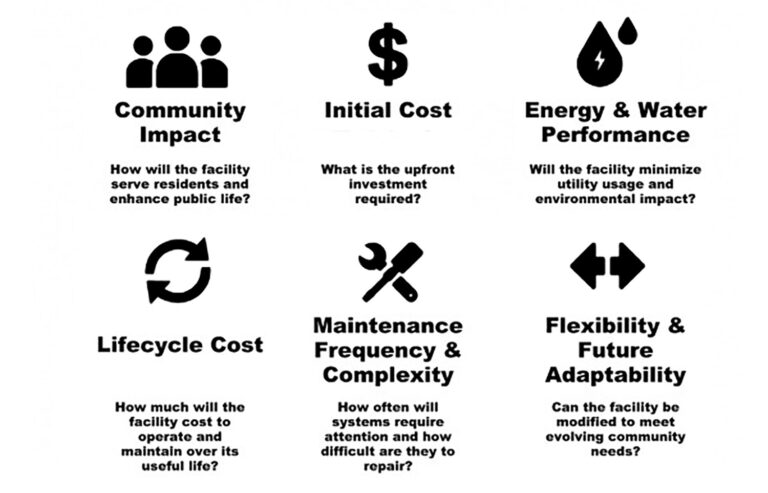
To be effective, a decision matrix should be supported by reliable data including design studies, manufacturer performance specifications, and detailed lifecycle cost analyses. Running multiple scenarios — such as comparing a budget-constrained option with a performance-driven one — can reveal cost sensitivities and help teams understand the long-term implications of their choices.
Just as important, documenting the rationale behind decisions promotes transparency and helps facilitate approvals from boards and oversight committees. These discussions often lead to difficult but necessary questions about community priorities. Is it worth building the largest possible facility today if future generations will face excessive maintenance costs or system failures?
When combined with procurement language that allows flexibility, a decision matrix shifts the conversation from “cheapest upfront” to “best-performing over time.” The following examples illustrate how this approach can change outcomes.
Example: Roofing systems
- Option A (lower upfront cost): Membrane roof; $500,000 installed; expected lifespan of 20 years; requires moderate maintenance; needs to be replaced twice over a 40-year period.
- Option B (higher upfront cost): Five-ply built-up roof; $812,500 installed; expected lifespan of 40 years; requires less maintenance; only one replacement needed over 40 years.
Example: Impact-resistant doors
- Option A (lower upfront cost): $50,000 installed; city emergency services could be disrupted immediately following a severe weather event due to system failure.
- Option B (higher upfront cost): $150,000 installed; no disruption to city services or emergency services after severe weather events.
When ongoing maintenance, inflation, and the financial impact of downtime or service interruptions are included in the analysis, higher upfront investments often result in significant long-term savings and improved reliability. Thoughtful design choices and durable materials should be prioritized, as they reduce future costs while enhancing day-to-day performance.
It’s also recommended that municipalities invest in:
- High‑efficiency HVAC systems with smart controls.
- Building envelope improvements such as added insulation and high‑performance windows.
- LED lighting with advanced controls.
- Durable flooring options like rubber epoxy or polished concrete.
These investments reduce energy use, lower heating and cooling demands, cut maintenance and replacement costs, and improve comfort and long‑term performance in public buildings.
Another useful strategy is to examine the expected replacement timeline for building systems and components and ensure construction materials are selected to meet those durations. Conversely, when funding must be prioritized, this approach can also guide leaders to invest less capital in its components with shorter service lives.
Sustainable public infrastructure through lifecycle thinking
Municipal facilities are long-term civic investments intended to serve communities for generations. Cities that embrace holistic planning, rigorous lifecycle analysis, and value-based procurement consistently deliver better buildings — facilities that are energy efficient, resilient, easier to maintain, and valued by the people who use them.
By redefining project success to emphasize overall lifecycle value rather than the lowest initial cost, municipal leaders can deliver smarter, more sustainable public assets that stand the test of time, and make a lasting positive impact on their communities.
As published in the March-April 2026 issue of Minnesota Cities, a League of Minnesota Cities magazine.

Phil is a senior architect at Bolton & Menk who began his career in 2011. He is responsible for assessments, space planning, concept designs, construction documents, and administration. With many years of experience, Phil has worked on wide variety of projects including commercial, industrial, and healthcare. His expertise lies in project delivery, building envelope design, and sustainable design. Phil is passionate about helping our client communities find solutions to fulfill their needs and goals.

As the building and architecture practice leader, Adam supports a talented team of architects and designers dedicated to creating safe, sustainable, and beautiful spaces. Since 2007, Adam has successfully managed projects ranging from $10,000 to $300 million, consistently delivering results that reflect a strong commitment to client goals. With experience spanning both public and private sectors, Adam brings a balanced perspective that helps teams harness the strengths of each environment. His leadership is driven by curiosity and a thoughtful, solutions-oriented approach—especially when guiding multidisciplinary teams through complex challenges. Outside the office, Adam and his wife are likely shuttling one of their three boys to a hockey rink or ballpark, fixing broken things, untangling fishing lines, or attempting to enjoy the quiet of the Midwest outdoors.
Tad Swedin
Tad is a practice expert in construction planning, preconstruction services, and client-focused facility development, beginning his career in 1996. At Bolton & Menk, Tad supports architectural design teams by providing in-depth construction analysis, cost estimating, scheduling, and guidance through the approval process. He also works directly with clients to assess current and future facility needs, ensuring that each solution is tailored to meet both technical and operational goals. Tad’s ability to translate complex project requirements into actionable strategies has made him a trusted advisor in the field. He is passionate about his work because it allows him to create meaningful, built solutions that solve real problems for clients.