
Revitalizing Downtown Chaska Through Collaboration
Home / Revitalizing Downtown Chaska Through Collaboration / Revitalizing Downtown Chaska Through Collaboration
The City of Chaska aimed to revitalize downtown as a community hub, preserving its historic character and small-town atmosphere. State Highway 41 and County Highway 61 traverse the downtown area, causing jurisdictional complexities that require informed decision-making, as solutions are unlikely to be straightforward. The downtown transportation network provided both opportunities and challenges to bring this vision to life.
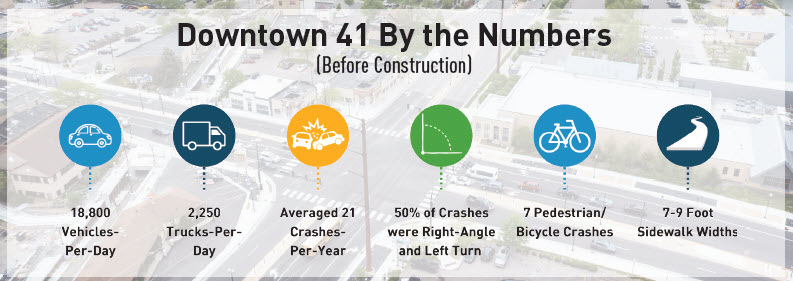
Lacking Safety Along Highway 41
Highway 41 is one of the few principal arterial roadways that directly cross a historic downtown in the Twin Cities Metropolitan Region. The original four-lane divided roadway, which included parking on the northbound lanes, left limited space for sidewalks, making the downtown area unwelcoming for non-motorized travel. Additionally, Highway 41 lacked turn lanes at intersections, causing disruptions as vehicles attempted to circumvent turning cars. Increased attention to pedestrian safety was directed to the corridor following a fatal incident involving a pedestrian crossing Highway 41 at 2nd Street in 2008. Improvements were necessary to enhance pedestrian safety and make downtown Chaska safer and more inviting for everyone.
Finding a Solution Through Collaboration
To assess various alternatives’ benefits and deficiencies, Chaska’s downtown transportation needs required a thorough review of engineering and planning measures. More than 80 meetings were held as part of the public and agency involvement process during the planning phase. To balance both local and regional transportation needs, The City of Chaska collaborated with Carver County, MnDOT, and Bolton & Menk on this transformative project. Ongoing collaboration and communication showed an unwavering commitment to finding a unified solution. Building on this shared vision, the team identified the following objectives that needed to be addressed:
- Corridor Character – Preserve and enrich the ambiance of historic downtown Chaska
- Non-Motorized Network – Provide a comprehensive network for non-motorized transportation that is compatible with major transportation corridors
- Vehicle & Pedestrian Safety – Safely accommodate all users along the major transportation corridors
- Corridor Mobility – Enhance vehicle mobility on the Highway 41 and County Highway 61 corridors
- Feasibility of Improvements – Provide infrastructure improvement compatible with the natural and human environment
- Project Costs – Develop a financially responsible infrastructure implementation plan
The vision for Highway 41 through downtown Chaska included a two-lane road with left and right turn lanes that better balanced roadway needs with the pedestrian space. To our knowledge, this is the first implementation of a “Road Diet”—a conversion from four-lanes to a two-lane divided roadway—on a Principal Arterial Roadway in the Twin Cities Metro area. The addition of streetscaping, pedestrian/bicyclist connections, and gathering spaces would create a more comfortable and inviting environment for all users, enhancing safety and accessibility while contributing positively to public space and urban development.

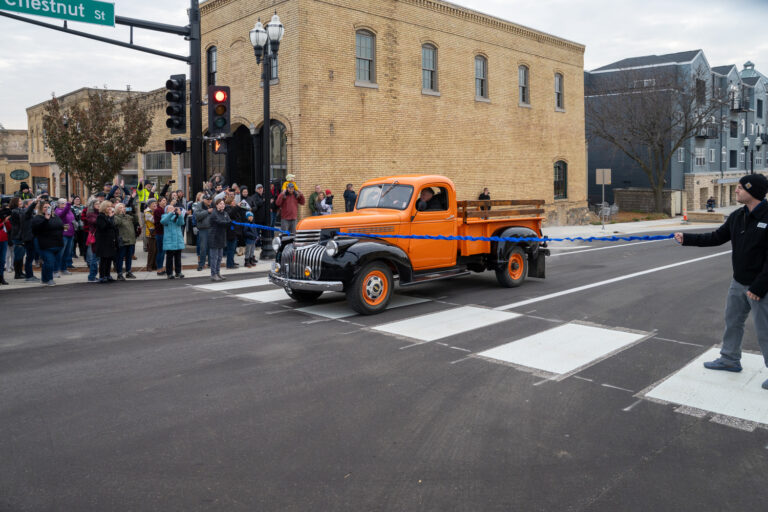
The October 2023 ribbon-cutting ceremony for the Downtown 41 Improvements project marked the culmination of nearly eight years of planning, public engagement, funding efforts, design, and construction. The $23 million construction investment has significantly reduced traffic crashes, enhanced local connectivity, and greatly expanded pedestrian accommodations, allowing Highway 41 to operate safely and efficiently. Without this project, MnDOT would have only completed a mill and overlay, and Carver County would have only replaced a deficient bridge. Instead, the project introduced a comprehensive improvement anchored by a two-lane divided section with local access, pedestrian enhancements, and additional streetscape and beautification along Highway 41. This innovative project serves as a model for future transportation initiatives, demonstrating how community-driven planning and multi-agency collaboration can successfully integrate local and regional goals.
As published in the North Central Institute of Transportation of Engineers (NCITE) Summer Newsletter. Learn more about how this innovative project established a safer, more beautiful downtown Chaska.