
Wellness, Scalability, & Community: The Future of Public Safety Facilities
Home / Wellness, Scalability, & Community: The Future of Public Safety Facilities / Wellness, Scalability, & Community: The Future of Public Safety Facilities
Public safety agencies face growing challenges in attracting and retaining qualified personnel. While competitive pay and benefits are critical, the physical environment where staff work every day plays an equally important role in recruitment, retention, and overall wellness. Thoughtful building design can help agencies create spaces that support their mission and their people. Buildings are more than operational hubs; they influence morale, health, and performance.
At the same time, communities vary widely in size and resources. There is no one-size-fits-all solution for public safety facilities. Employee and organizational sustainability can be enhanced by designing and building facilities that not only meet today’s needs but are easily adjusted as the organization grows and develops. The question is not whether wellness, recruitment, and retention features can be implemented; it’s how to scale them effectively so every agency can benefit.
Scaling Wellness for Every Budget
Public safety work is both physically and emotionally tough. Designing facilities that promote wellness goes beyond traditional physical care. The recognition that emotional and mental wellbeing are equally important to effective service delivery is more apparent than ever. According to MnFIRE, firefighters face a 9% higher risk of being diagnosed with cancer and a 14% higher risk of dying from cancer compared to the general U.S. population. Cardiovascular disease remains a leading cause of line-of-duty deaths in the fire service. Mental health concerns are equally alarming with both law enforcement officers and firefighters, showing higher rates of PTSD, depression, and suicide. These statistics highlight why wellness must be a priority in public safety facility design, regardless of budget. How can this be achieved? Recognizing that communities desire to be fiscally responsible, we have a dedicated team of project funding specialists that know where to look, and how to apply, for municipal project funding sources.
For agencies with larger budgets, wellness can be supported through features like on-site fitness centers, dayrooms and sleeping quarters for extended shifts, and private wellness rooms for counseling or decompression. These spaces provide dedicated areas for physical health and mental recovery, reinforcing a culture of care.
Smaller communities can also make meaningful improvements without major investments. Upgrading common spaces with calming paint colors, reorganizing layouts to maximize natural daylight, and converting underutilized rooms into private areas for mental health support are practical, cost-effective strategies that enhance well-being.
Regardless of budget, certain features should be prioritized in every facility. Adequate ventilation systems and safe working conditions create a healthier, more supportive environment for those who serve our communities.
Facilities that Attract and Sustain Talent
Today’s public safety profession is addressing a changing workforce. Recruiting and retaining the best team to serve the community is at the forefront of many agencies. The design of infrastructure and work environments that speak to the value and sacrifice of its team members can be a powerful reinforcement. A public safety facility demonstrating pride and commitment to the team can effectively spread amongst staff demonstrating pride and commitment to the community they serve.
Instead of relying solely on cash bonuses, which provide short-term satisfaction, agencies can invest in long-term improvements like safe and secure workspaces, wellness rooms, team gathering spaces, and advanced technologies. These upgrades keep resources within the organization while signaling a commitment to employee well-being.
For larger communities with bigger budgets, this might mean technology-enabled training rooms, ergonomic workstations, and dedicated decompression spaces for mental health breaks. Flexible layouts that adapt to evolving needs also show long-term commitment to staff well-being.
For smaller communities with tighter budgets, meaningful improvements are still possible. Fresh paint, updated signage, and improved lighting can make a strong first impression. Repurposing underutilized spaces into employee amenity spaces can enhance comfort and safety without major renovations. Even these modest changes can reduce fatigue, improve morale, and help agencies recruit and retain the professionals who keep communities safe.
Design on a Budget: Hankinson’s Commitment to Wellness and Workforce
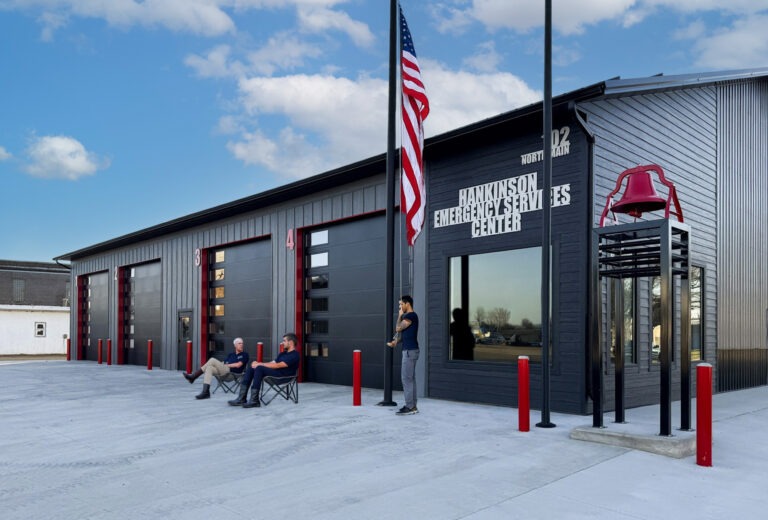
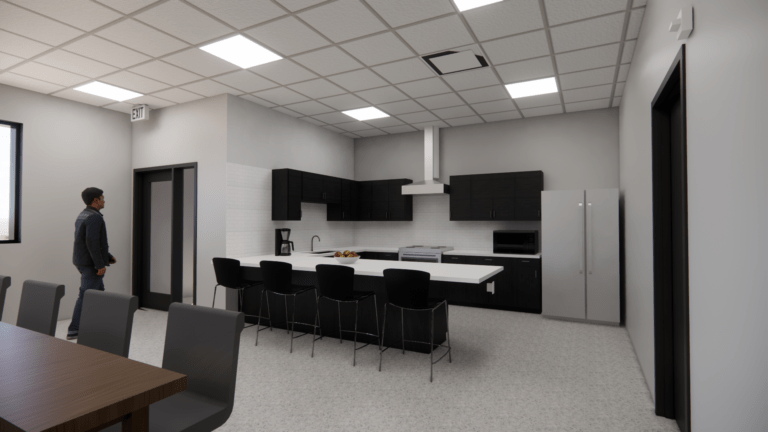
The Hankinson Emergency Services Center in Hankinson, ND demonstrates this commitment to wellness, recruitment, and retention. The new public safety facility includes a dedicated decontamination space to reduce exposure risks, along with modern mechanical systems that improve air quality—lacking from the existing facility but critical to long-term health. The space includes a shared kitchen and meeting room, to comfortably fit all squad members. The 13,000 SF facility is scheduled for completion in May 2026 with a budget of approximately two million dollars. These features show how wellness can be integrated into design at any budget. The space includes a shared kitchen and meeting room, to comfortably fit all squad members. The 13,000 SF facility is scheduled for completion in May 2026 with a budget of approximately two million dollars. These features show how wellness can be integrated into design at any budget.
The Path Forward
Designing infrastructure that enables public safety professionals to care for and serve their communities is foundational. Understanding community priorities and organizational culture is the critical first step toward success. This philosophy turns challenges into opportunities by creating spaces that attract and retain top talent while supporting physical, emotional, and mental well-being. Through wellness features and practical, cost-conscious design strategies, solutions can be scaled to fit any budget, ensuring every community invests in the people who protect it.
Authors
Adam Luckhardt, AIA
As the firm’s building and architecture practice leader, Adam is responsible for advising architecture staff and helping complete assessments, space planning, concept designs, construction documents, and administration for our clients. Since starting his career in 2007, he has led projects ranging from $10,000 to $200 million, providing creative solutions tailored to each project. Prior to joining Bolton & Menk, Adam spent 17 years at two architecture firms with national footprints. He is experienced working with large, multidisciplined teams. Adam is committed to being a partner who will listen, understand, and deliver a project that will meet the long-term goals of each client.
Meagan McColloch-Vencil, AIA, AICP
Meagan is a senior architect at Bolton & Menk who began her career in 2012. A dual-credentialed architect and planner, she brings a unique perspective to leading the design process from the conceptual phase through construction. Her areas of expertise include site and building assessments, public engagement, space programming, and campus planning. Meagan is passionate about finding solutions that have a positive impact within our client communities.
Gregory Weber
Greg is a strategic development specialist at Bolton & Menk. He began his professional career in 1989 and his expertise spans the areas of public safety, organizational development, leadership mentoring and coaching, and municipal government operations. Greg’s passion for the field stems from working with people and seeing their goals and expectations surpassed.