
Building Momentum Through Public and Private Partnerships in Algona
Home / Building Momentum Through Public and Private Partnerships in Algona / Building Momentum Through Public and Private Partnerships in Algona
For many Iowa cities, downtown street reconstruction projects begin as responses to aging pavement, outdated utilities, and necessary accessibility updates. Now more than ever, communities are regarding these investments as opportunities to advance broader goals related to their economic development, placemaking, and quality of life. The City of Algona’s Cultural District Master Plan demonstrates how strategic public and private partnerships, paired with thoughtful streetscape implementation, can build momentum for long-term downtown revitalization.
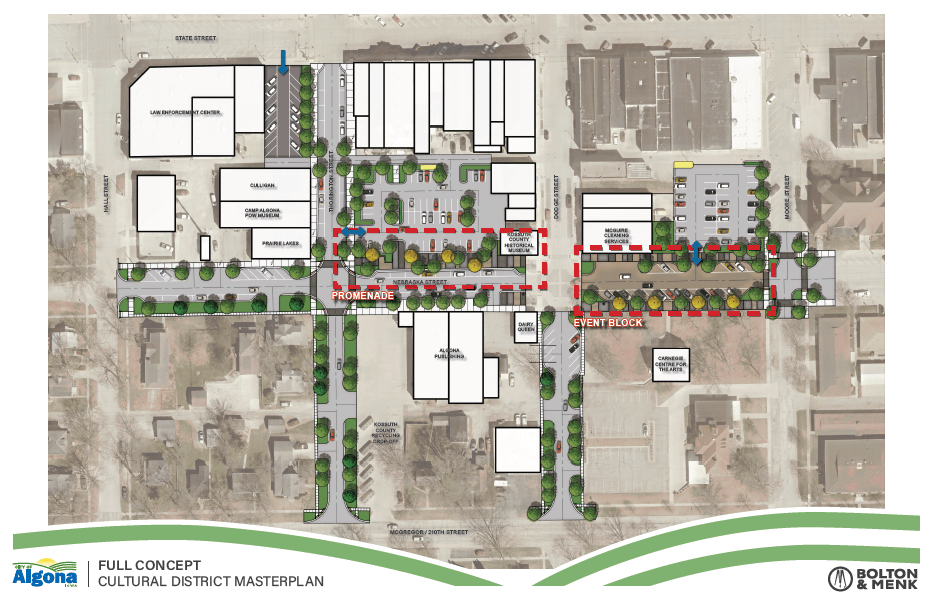
The Cultural District is anchored by the reconstruction of a key downtown corridor, connecting several of Algona’s cultural institutions: Camp Algona POW Museum, Kossuth County Historical Society Museum, and the future Carnegie Centre for the Arts. Given the corridor’s role in linking these destinations, the city recognized that decisions made during design and construction would shape how residents and visitors experience downtown. Rather than limiting the project to basic infrastructure replacement, Algona leveraged reconstruction as an opportunity to align transportation improvements with cultural identity, community celebrations, and economic activity.
Planning Beyond the Pavement
Early in the planning process, city leaders identified the importance of connecting infrastructure investments to broader community outcomes. The focus extended beyond just how to rebuild the street and transformed into how it could support cultural programming, heritage tourism, and long-standing city traditions. This shift in perspective encouraged collaboration among city departments, cultural organizations, business owners, and community stakeholders.
Through the master planning effort, participants identified shared goals for Algona: improving pedestrian comfort, creating flexible space for public events, enhancing stormwater management, and reinforcing the Cultural District as a cohesive, walkable destination. The plan explored how existing community celebrations could be better supported by permanent infrastructure, reducing reliance on temporary closures.
Designing Streets for Multiple Uses
A defining characteristic of the Cultural District streetscape is its flexibility. The reconstructed corridor was designed to support everyday activities—walking between museums, relaxing on a bench under the canopy of the trees, and accessing downtown businesses—while also accommodating festivals, parades, performances, and seasonal celebrations.
Wider sidewalks and clearly defined pedestrian zones provide space for increased foot traffic, spectator areas, and temporary installations such as vendor booths or historical displays. Durable paving materials allow for parade routes, marching bands, and event equipment without compromising long-term street performance, while lighting and electrical access was incorporated to support evening celebrations.
These design features ensure that community events can occur with less disruption and fewer logistical barriers, making downtown celebrations more accessible for participants and visitors.
Supporting City Celebrations and Traditions
Algona’s Cultural District is designed to serve as a central gathering space for long-standing city celebrations:
Band Day is a 78-year tradition that draws about 4,000 people to Algona’s downtown. Multiple high school marching bands and community floats are joined by local families and visiting spectators for this annual parade. Streetscapes with wide sidewalks and accessible routes allow for easy viewing and attendance.
Founders’ Day uses the Cultural District’s event spaces for live music events, art fairs, and food trucks, with nearby museums connecting Algona’s past to its present.
With these events in mind, infrastructure was added to assist with event management, electrical outlets in the light poles, electrical pedestals, and the elimination of curbs to reduce tripping hazards.
Integrating Green Infrastructure
Green infrastructure was made central to the streetscape design for multifunctional purposes. Landscape plantings, street trees, permeable pavers, rain gardens, and biocell elements were integrated into the reconstructed corridor to increase stormwater capacity and improve runoff management, in addition to creating a more pedestrian-friendly space for people to enjoy.
From an environmental standpoint, these elements support sustainable infrastructure goals by reducing pressure on traditional stormwater systems. From a community standpoint, they enhance comfort and visual appeal, encouraging visitors to linger as they move between destinations. Shaded seating areas and plantings contribute to a streetscape that feels intentional and welcoming.
Integrating green infrastructure allowed Algona to address sustainability and placemaking objectives simultaneously, avoiding the need for future retrofits and maintaining a cohesive design.
Working with the Iowa Department of Agriculture and Land Stewardship (IDALS), the city obtained an Urban Water Quality Initiative (WQI) grant to cover a portion of the green infrastructure construction costs.
Leveraging Cultural Partnerships
Public and private partnerships were central to advancing the Cultural District vision. The proximity of the museums and cultural institutions fostered collaboration, with a shared goal of attracting visitors and animating downtown public spaces.
For Iowa cities with cultural or heritage institutions, Algona’s experience demonstrates how aligning infrastructure projects with mission-driven partners can expand capacity, strengthen funding strategies, and build momentum beyond the project itself.
Supporting Growth and Future Economic Development
While streetscape reconstruction addressed immediate infrastructure needs, its greater value lies in what it enables. An inviting, event‑ready downtown supports small businesses by increasing foot traffic and encouraging visitors to spend more time in the area. Cultural programming—performances, walking tours, farmers’ markets, and art events—reinforces Algona’s identity as a cultural destination and strengthens collaboration among local institutions, maximizing the use of public space.
Notably, the Cultural District serves as a platform to hold various event types, not focused on one singular function. The streetscape provides the physical framework, while partners and community groups define how the space is used. This flexibility allows the district to evolve as community interests and programming change, extending the life and relevance of the investment.
Lessons for Iowa Cities
Algona’s Cultural District offers several lessons applicable across Iowa:
- Use reconstruction projects to connect infrastructure with cultural and economic goals
- Establish a shared vision that aligns infrastructure with cultural programming
- Design streets to accommodate both daily use and events
- Integrate green infrastructure to enhance pedestrian comfort
- Leverage cultural institutions as anchor partners
- Plan for long-term operational flexibility
As Iowa cities invest in downtown infrastructure, Algona’s experience shows how building momentum through public and private partnerships and designing for community celebration can turn necessary reconstruction into lasting civic value.
Outdoor spaces play a vital role in connection and community health. Our work focuses on delivering solutions that respond to community needs and create lasting, positive impacts.
As published in the Iowa League of Cities – Cityscape April Issue.
Matthew Cole
Matthew is a project engineer who is responsible for project management, plan and specification preparation, municipal design, and construction observation. He enjoys seeing a project progress from concept through final construction. Matt has experience with preliminary layout and design, preparation of feasibility reports, cost and quantity take off estimates, detailed inspection, and project documentation. He began his engineering career full time in 2011 after spending four summers as an intern. He loves building client relationships and tries to keep all parties involved in a project happy by communicating frequently.