
Coralville’s Stream Mitigation Bank: Funding Greenway Parks
Home / Coralville’s Stream Mitigation Bank: Funding Greenway Parks / Coralville’s Stream Mitigation Bank: Funding Greenway Parks
In the heart of Iowa, the City of Coralville is pioneering a new approach to urban conservation—one that blends regulatory compliance, ecological restoration, and public recreation into a single, replicable framework. By integrating stream mitigation banking into its greenway park system, Coralville is demonstrating how cities can meet federal environmental requirements while enhancing the quality of life for residents.
The Challenge: Balancing Development and Ecology
Under Section 404 of the Clean Water Act, any project that impacts streams or wetlands must offset those impacts by purchasing credits from certified mitigation banks. For cities, this often means navigating complex regulatory landscapes while trying to preserve or expand green spaces. Coralville faced this challenge head-on, recognizing that traditional mitigation banking, often managed by private entities, could be reimagined as a public asset.
The Solution: A City-Owned Mitigation Bank
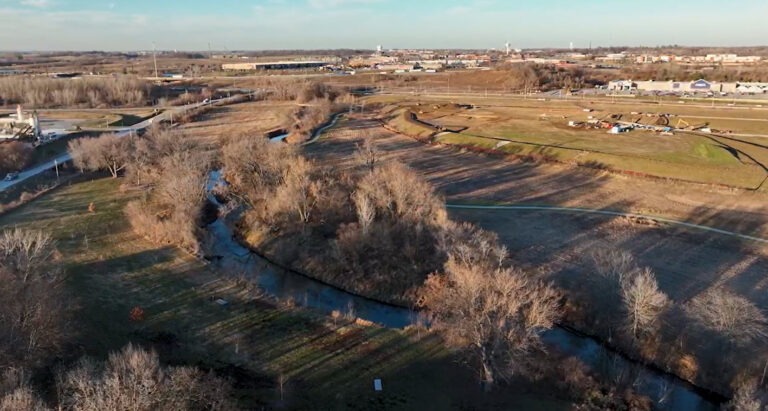
Coralville’s response was bold and strategic. The city established a general-use stream mitigation bank within its greenway system, specifically targeting portions of Clear Creek and Becky’s Creek.
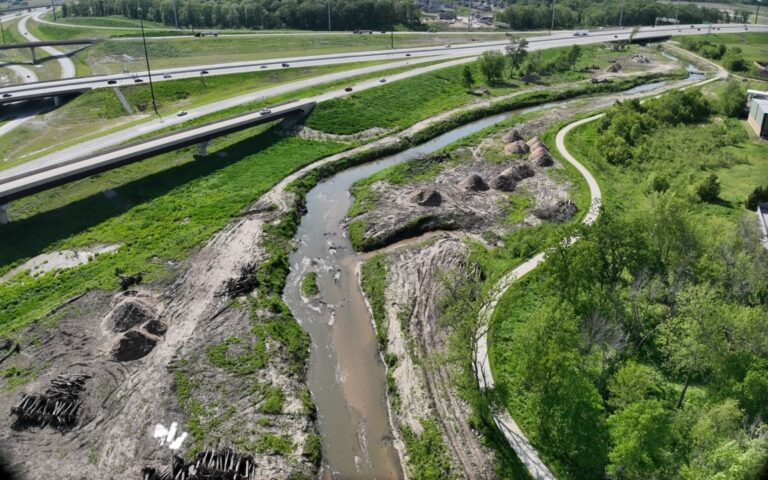
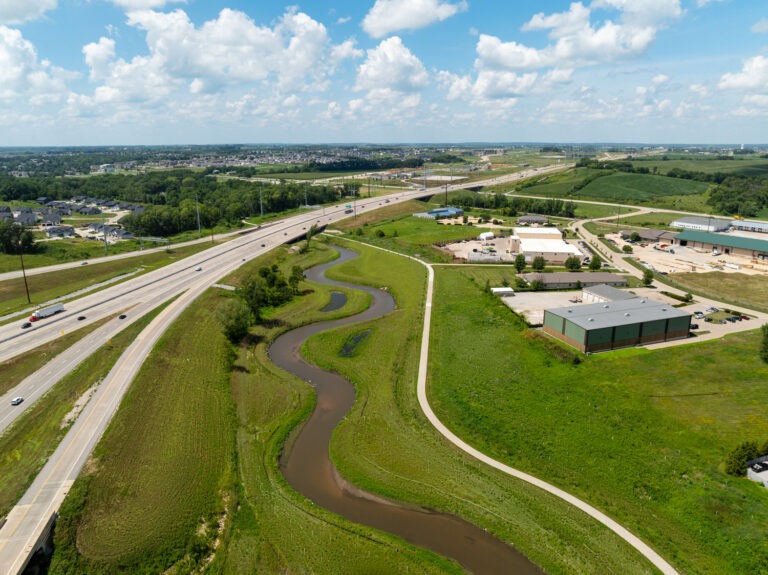
These urban stream corridors were restored through in-stream improvements, riparian buffer enhancements, and re-meandering of straightened channels to increase stream length and reduce erosion. The project greatly improved a two-mile stretch of stream and riparian corridor, as well as a small intermittent tributary. Several stream stabilization practices were designed and incorporated into the project, including extensive bankfull benching, floodplain reconnection, boulder clusters, cross vanes, step pools, root wads, toe wood, stone toe, rock constructed riffles, meander scars, and more than 50 acres of native plantings.
Within Becky’s Creek, a small tributary of Clear Creek, timber stand improvements consisted of removing invasive vines and shrubs such as honeysuckle and Chinaroot, while creating an open understory to allow for hickory and oak regeneration, and expansion of native forbs. The plating mix for this area is designed specifically for shady woodlands and includes many spring-flowering forbs which provide critical foraging for spring pollinators. Non-desirable herbaceous species were removed along with invasive and non-native shrubs and vines, which were appropriately treated with a herbicide to prevent regrowth. This floodplain area was seeded with the understory seeding mix, and areas along the creek were seeded with the stream bank seeding mix.
Timber stand improvements within Clear Creek included removing many silver maple trees, planting between 25 and 50 trees per acre depending on the designated area, with 1,093 trees planted overall. Five tree species were developed for the project, each selected for distinct buffer areas within the riparian corridor and chosen to tolerate current site conditions, reflect historic species, and introduce additional native species to ensure diversity. The tree species chosen for each mix were planted in groupings of 5 to 11 trees, including three hard mast-producing trees at minimum. The mast-producing trees provide a critical food source for wildlife during the fall and winter months.
Within all three reaches, specific on-site trees were harvested to be used for instream practices such as the toe wood and root wads, and for habitat creation within the stream for aquatic species. All tree removals took place after October 1 and before March 31 to avoid impacts to endangered bat habitat. The toe wood and root wads used in Clear Creek provide excellent aquatic habitat while dissipating streamflow energy away from the banks and allowing vegetation to establish.
A highly detailed grading plan was developed and implemented. The grading plan included several ‘meander scars’ within the floodplain benches. They are shallow pools of standing water intended to simulate the scars from old channel beds that can be found in historically meandered channels where the channel has migrated over time.
The detailed grading plan also included a pre-sloped channel bottom, simulating deeper pools of water along outside bends of the creek and shallow point-bars on the inside bends. Conventional channel design too often includes a flat cross-sectional bottom, but inevitably the stream will carve out its own bed slopes over time. By pre-sloping the channel bottom, the stream could flow optimally immediately, providing habitat in the deeper outside pools and reducing the bed erosion and movement that would otherwise have occurred.
What sets Coralville apart is its decision to embed this restoration work within public parks. The mitigation bank not only satisfies federal requirements but also funds ongoing greenway management. Revenue from credit sales is reinvested into forest management, invasive species control, native vegetation planting, and biodiversity enhancement, all within the city’s own park system.
Public Benefit: Recreation Meets Resilience
The impact of Coralville’s model extends far beyond compliance. Restored stream corridors feature paved trails, single-track mountain bike paths, a disc golf course, and water trails that invite residents to explore nature in their own backyard. These greenways serve as ecological lifelines, improving water quality, supporting wildlife, and offering flood protection in an era of increasing climate volatility.
By aligning environmental restoration with recreational development, Coralville has created spaces that are both functional and inspiring. Residents benefit from improved access to nature, while the city gains a sustainable funding source for conservation efforts.
A Model for Other Cities
Coralville’s approach provides an example for municipalities in Iowa and elsewhere. It demonstrates how cities can fulfil Clean Water Act requirements using locally managed mitigation banks, allocate mitigation revenue to conservation and park maintenance, and increase urban green spaces that connect people with nature.
The financial viability of this approach is clear. Coralville estimates its mitigation bank could generate up to $12 million in credit sales over 15 years—funds that will be reinvested directly into the community.
What Cities Can Learn
City officials will learn how to plan mitigation banking in public green spaces, use mitigation credits for forest management and biodiversity, and integrate environmental restoration with recreational infrastructure.
Coralville’s initiative is a vision for how cities can thrive ecologically, economically, and socially. By turning regulatory obligations into opportunities for public good, Coralville is setting a new standard for urban resilience and community engagement.
As published in the Iowa League of Cities – Cityscape October Issue.
Explore how your city can turn regulatory requirements into community assets. Connect with our water resources experts to learn how we can protect your environmental resources now and for years to come.

Ryan M Benjegerdes, PE, CFM
Water Resources Practice
Leader | Principal, Bolton & Menk
(515) 425-4417