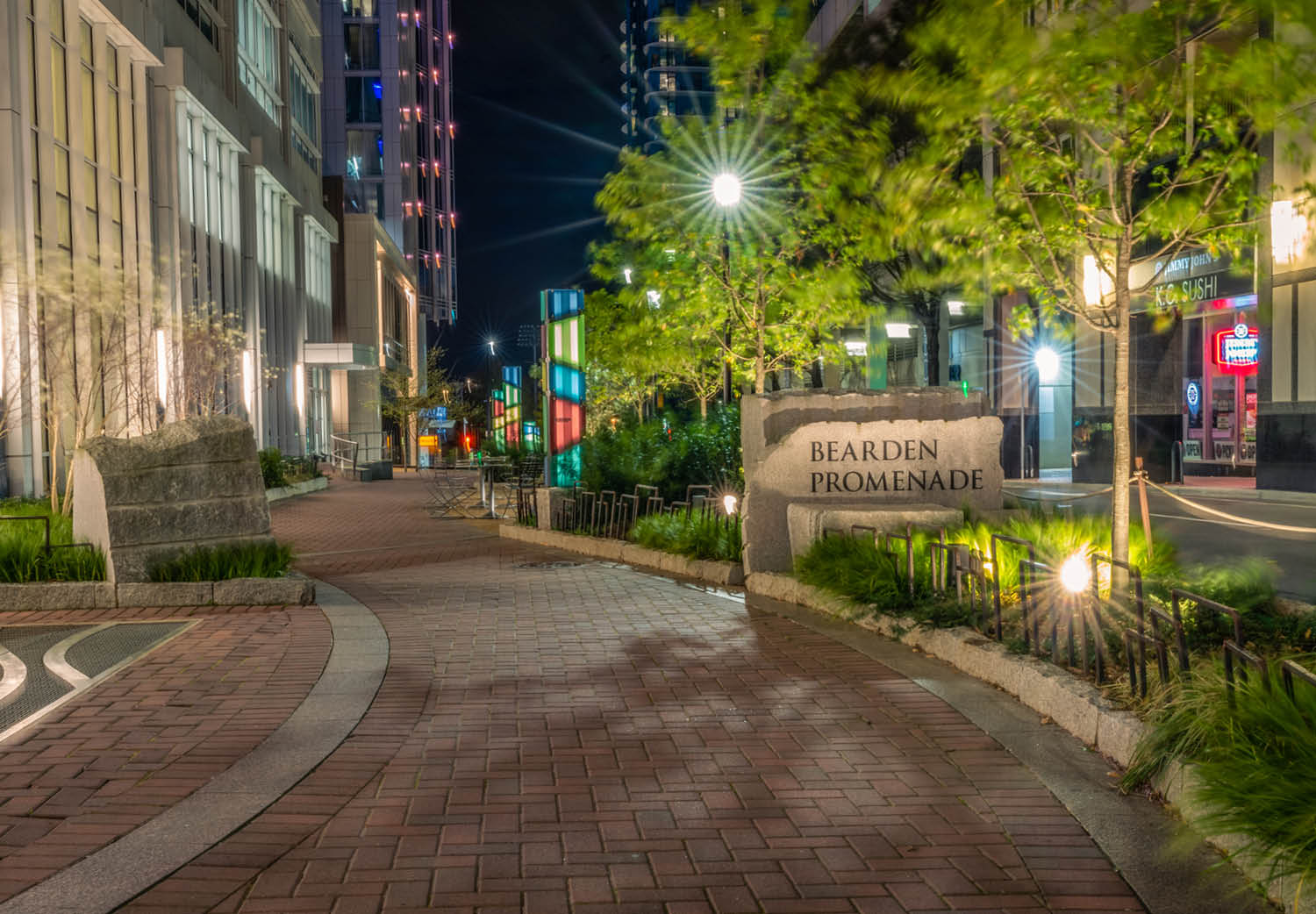
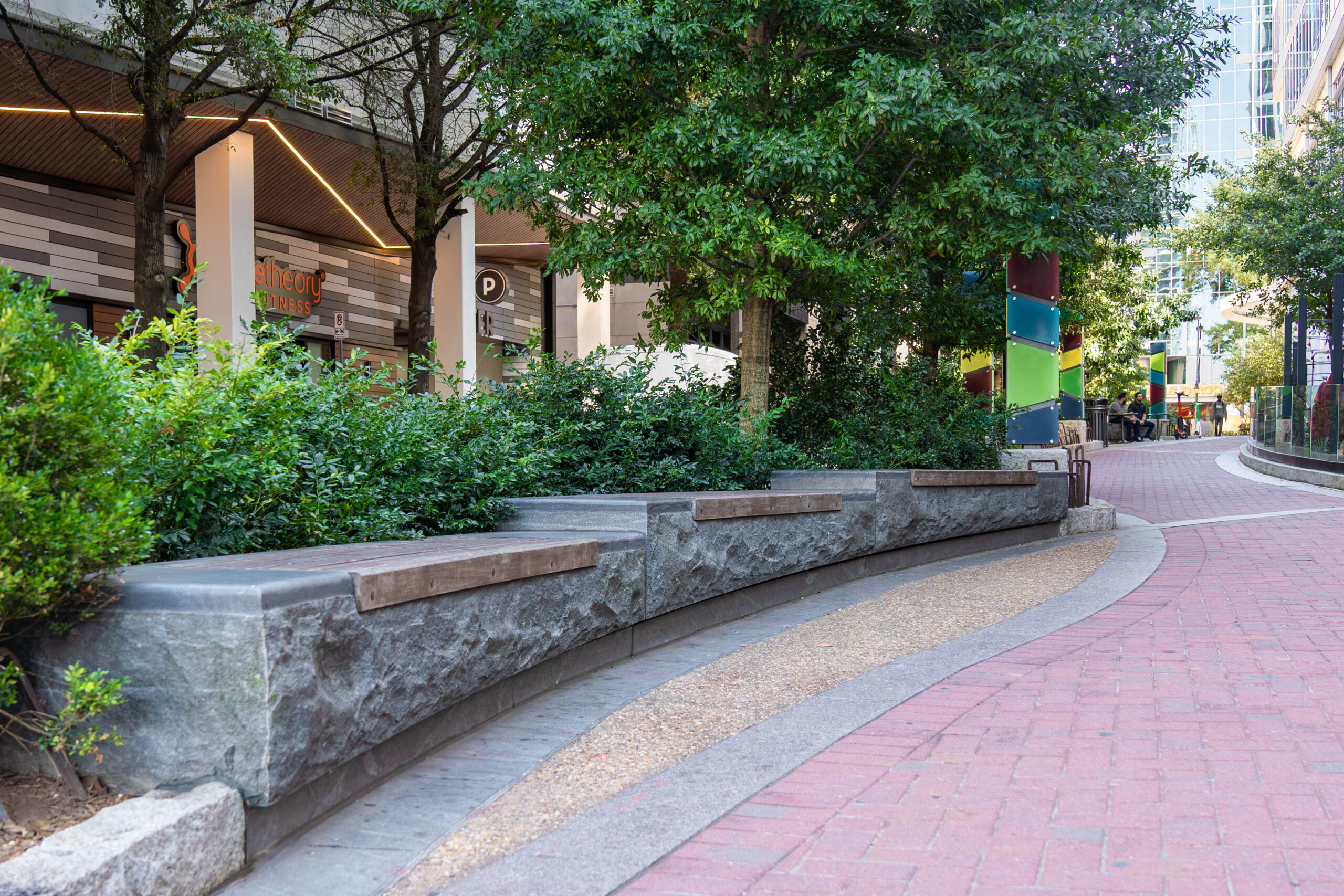
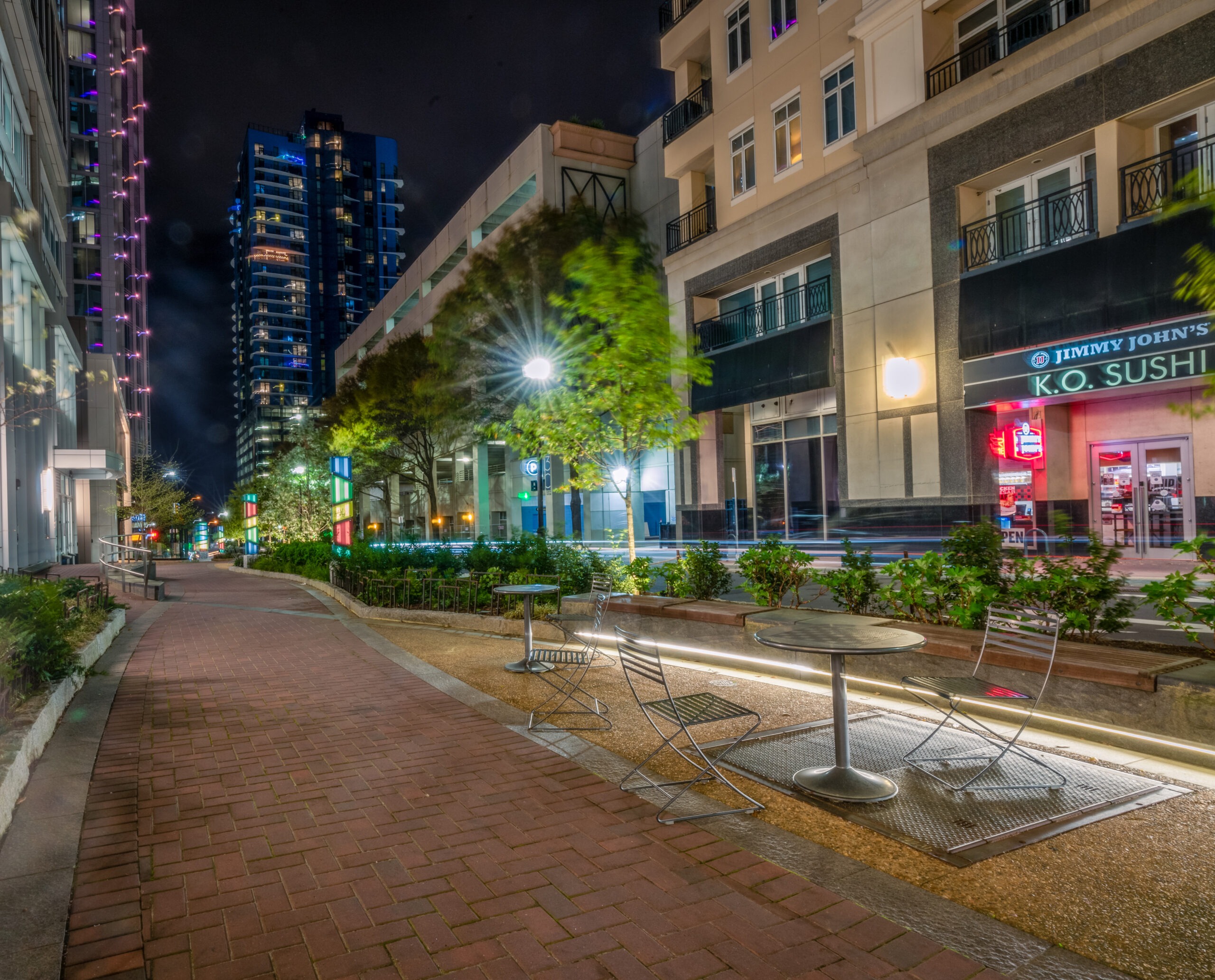
Located in Uptown Charlotte’s Third Ward, the Bearden Promenade is a 425-foot-long, 35-foot-wide linear pedestrian corridor that establishes a critical east-west connection between South Tryon Street and Romare Bearden Park. Envisioned as a signature urban streetscape, Bearden Promenade strengthens connectivity and reinforces visual continuity within the heart of Uptown Charlotte. The corridor features a carefully curated collection of richly detailed architectural and landscape elements—including gateway signage, illuminated vertical markers, and a blend of fixed and flexible site furnishings—designed to create a dynamic and engaging public realm. A dense understory and a semi-continuous canopy of shade trees help define the spatial character of the promenade. This layered planting approach creates a shaded, park-like environment in the heart of Uptown Charlotte, offering moments of relief and tranquility along the pedestrian corridor.
Bolton & Menk, Inc. provided both Landscape Architecture and Civil Engineering Services for Bearden Promenade. In partnership with a skilled team of long-standing collaborators and subconsultants, the design team was tasked with delivering a signature streetscape in Uptown Charlotte for Mecklenburg County. Their involvement was essential in navigating the project’s complex layers of regulatory approvals, overlapping property ownership, and long-term maintenance responsibilities. Although primarily a public park, Bearden Promenade was designed and constructed in tandem with the adjacent office and hotel developments, meeting regulatory requirements for both public and private components. Early in the process, the design team led stakeholder workshops to gather input from both public and private entities—a collaborative effort that continued throughout the project and proved critical to its successful implementation.
The promenade is the result of a successful collaboration between public and private stakeholders, reflecting a shared commitment to enhancing the urban environment. In addition to connecting South Tryon Street to Romare Bearden Park, the project also provides urban open space for the adjacent, award-winning 300 South Tryon development. The iconic office tower, a collaboration between The Spectrum Companies and LS3P Architects. The project offers 638,000 SF of office space and approximately 20,000 SF of retail and features a Kimpton Tryon Park Hotel. Approximately half of the promenade directly interfaces with the adjacent development and, in select areas, is constructed atop the subsurface structure of the office tower. The remaining width of the park was made possible through a road diet, implemented in coordination with the City of Charlotte, which repurposed a former travel lane along West Third Street—running parallel to the promenade—into public open space.
The initial vision for the Bearden Promenade emerged in 2014, developed in parallel with the design of the adjacent office tower. Mecklenburg County Park and Recreation later finalized the design and facilitated construction of the streetscape and linear park. Built over a 10-month period—from approximately February to December 2017, the promenade was completed in tandem with the adjacent office building and hotel. Serving as both landscape architect and civil engineer for the office tower and promenade, Bolton & Menk played a key role throughout the process, facilitating and participating in stakeholder workshops, focus groups, and coordination meetings. This continuity was essential in aligning public and private interests throughout the design process. As a result of this collaboration, outdoor dining for the hotel restaurant and a walk-up coffee window were integrated into the design, strengthening the relationship between indoor and outdoor spaces.
Nearly every element of the park is custom designed to respond to the site’s unique constraints. The shade-oriented landscape distinguishes the promenade from typical streetscapes, with approximately half of the corridor constructed as an intensive green roof above a 408-space subsurface structure. Custom stainless steel curvilinear strips were applied to the building’s ventilation grates, echoing the promenade’s meandering path—transforming a utilitarian, visually intrusive element into a defining architectural feature that reinforces the identity and cohesion of the streetscape. To support healthy root development for the extensive tree and shrub plantings, the design team implemented a reinforced concrete slab system beneath the granite and concrete paver sidewalks. This structure spans over planting zones, enabling generous below-grade root areas. Integrated subsurface drainage ensures effective water management throughout the corridor.
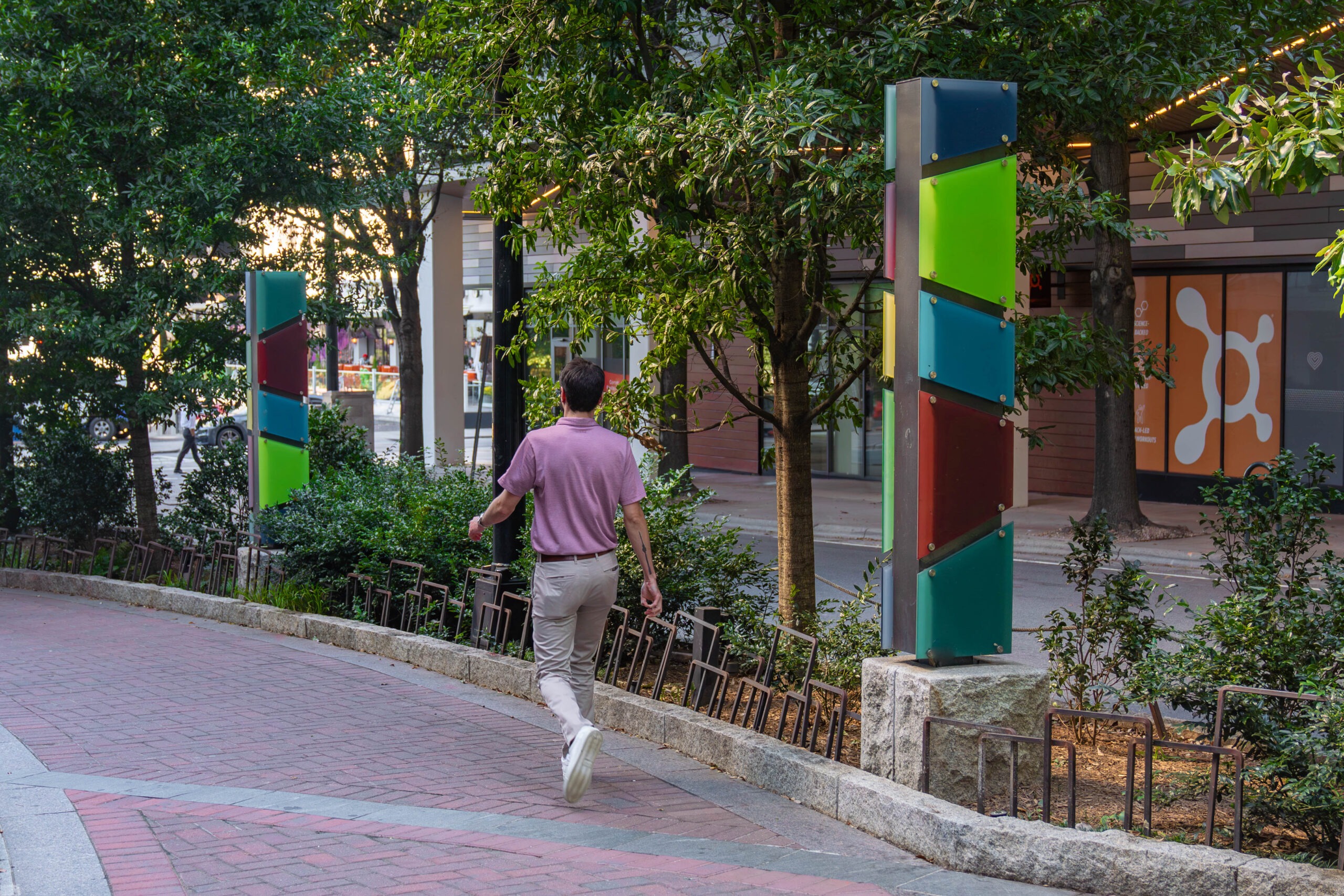
To enrich the visual experience along the promenade and subtly guide pedestrians toward Romare Bearden Park, the design incorporates a series of custom-fabricated illuminated pillars. The installation features one primary column standing at 11½ feet and six secondary columns at 8½ feet, serving as both visual landmarks and pedestrian-scale lighting elements. Each pillar is internally lit and constructed with Lumicor resin panels supported by a structural steel frame. The bases are clad in White Mount Airy Split-Face Granite, offering durability and a refined material contrast. The columns’ distinctive color palette and geometric patterns echo design motifs from Romare Bearden Park, reinforcing a cohesive visual language and enhancing orientation and visibility throughout the day and night.
Several materials and textures from the adjacent Romare Bearden Park were thoughtfully extended into the promenade, including custom granite boulders hand selected from The North Carolina Granite Corporation’s Mount Airy quarry to match the park’s signature finishes. One of these boulders features an etched ‘Bearden Promenade’ inscription, establishing a formal entry point and reinforcing the space’s identity.