Water Distribution Hydraulic Modeling
Home / Water Distribution Hydraulic Modeling / Water Distribution Hydraulic Modeling
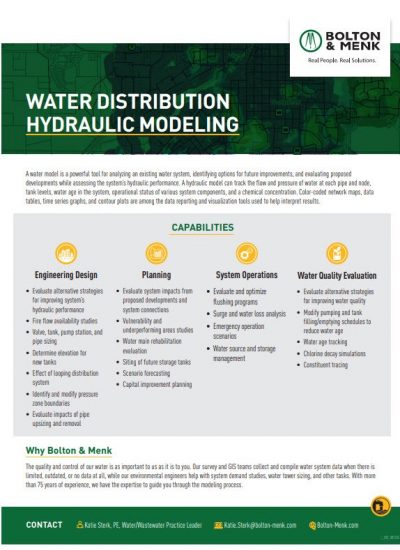
A water model is an essential tool for analyzing existing water systems, identifying improvement options, and evaluating proposed developments while assessing hydraulic performance. It tracks water flow and pressure at each pipe and node, tank levels, water age, operational status of system components, and chemical concentrations. Data reporting and visualization tools, such as color-coded network maps, data tables, time series graphs, and contour plots, help interpret results.
Capabilities
Engineering Design: Evaluate strategies for improving hydraulic performance, conduct fire flow studies, size valves, tanks, pump stations, and pipes, determine tank elevations, assess looping distribution systems, modify pressure zone boundaries, and evaluate pipe upsizing and removal impacts.
Planning: Assess system impacts from developments and connections, study vulnerabilities and underperforming areas, evaluate water main rehabilitation, site future storage tanks, forecast scenarios, and plan capital improvements.
System Operations: Optimize flushing programs, analyze surge and water loss, plan emergency operations, and manage water sources and storage.
Water Quality Evaluation: Improve water quality, adjust pumping and tank schedules to reduce water age, track water age, simulate chlorine decay, and trace constituents.
Why Bolton & Menk: With more than 40 years of experience, our survey and GIS teams collect and compile water system data, while our environmental engineers assist with demand studies and water tower sizing, ensuring quality and control throughout the modeling process.
Contact Katie Sterk, PE, principal water/wastewater project manager, to learn how our expertise in water distribution hydraulic modeling can enhance your water system’s performance.