As public agencies in Oregon and California demolish massive dams along the Klamath and other major rivers, smaller communities nationwide are replacing their own modest dams with more natural, fish-friendly systems. In Pine River, Minnesota, a working-class town of roughly 900 people, an aging 200-foot-long dam has been redesigned as a series of stepped naturalist rock rapids flanked by wildflowers and other native riparian plantings, a change that has generated public investment upstream and down.
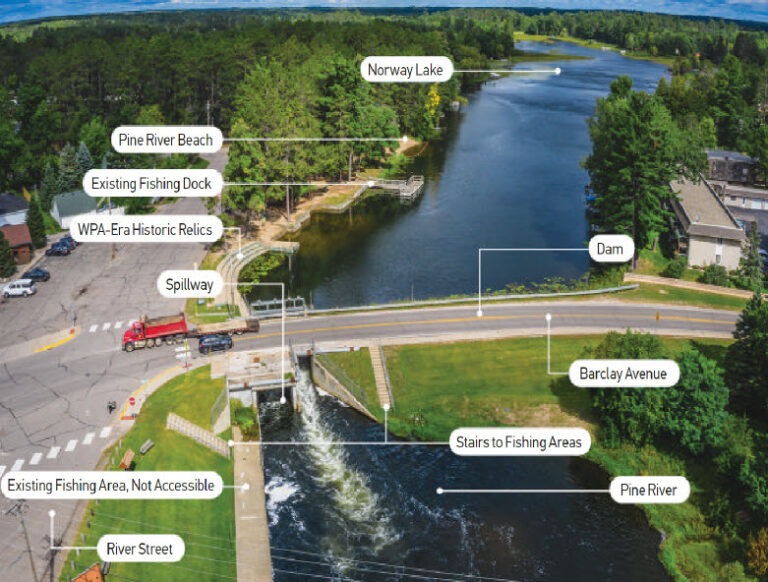
The opportunity to rethink Pine River’s riverfront followed a decision but the Minnesota Department of Transportation to rebuild a bridge over the river and decouple the road from the dam that supported it. A 2014 feasibility study commissioned by the City of Pine River and led by the multidisciplinary firm Bolton & Menk laid out the options for city officials and residents. Townspeople overwhelmingly supported replacing the dam with rapids, also known as a rock riffle, which was more cost-effective than building a new dam and also improved access, fish habitats, and public safety. “People wanted to see it returned back to natural [state],” says Mike Hansen, the town’s public works director. Aided by a $2.2 million grant form Minnesota’s Lessard-Sams Outdoor Heritage Council and a municipal bond, the re-naturalization of the Pine River and 134 lakes. Still the former dam and spillway, located a few blocks from downtown, had users too. A set of curved steps built by the Works Progress Administration (WPA) attracted those who wanted a view, while anglers congregated on a concrete pad just downstream. The latter emerges as one of the community’s “sacred cows,” say Samuel Kessel, ASLA, a principal and landscape architecture practice leader at Bolton & Menk, which lead the project’s implementation. Working with state officials and consultants, the landscape architects enhanced these access points, regarding the western bank so the fishing area could be reached by a more gently sloped stair and an ADA-accessible ramp.
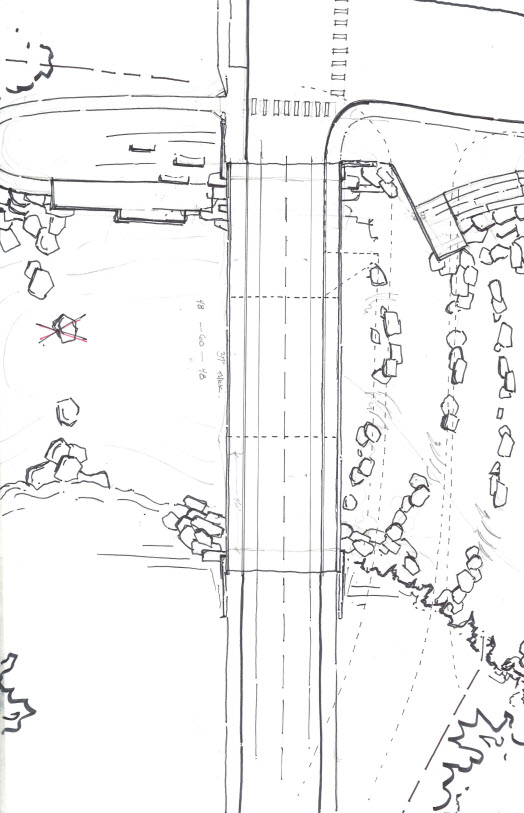
An early sketch of the rock riffle Pine River residents selected to replace an existing dam.
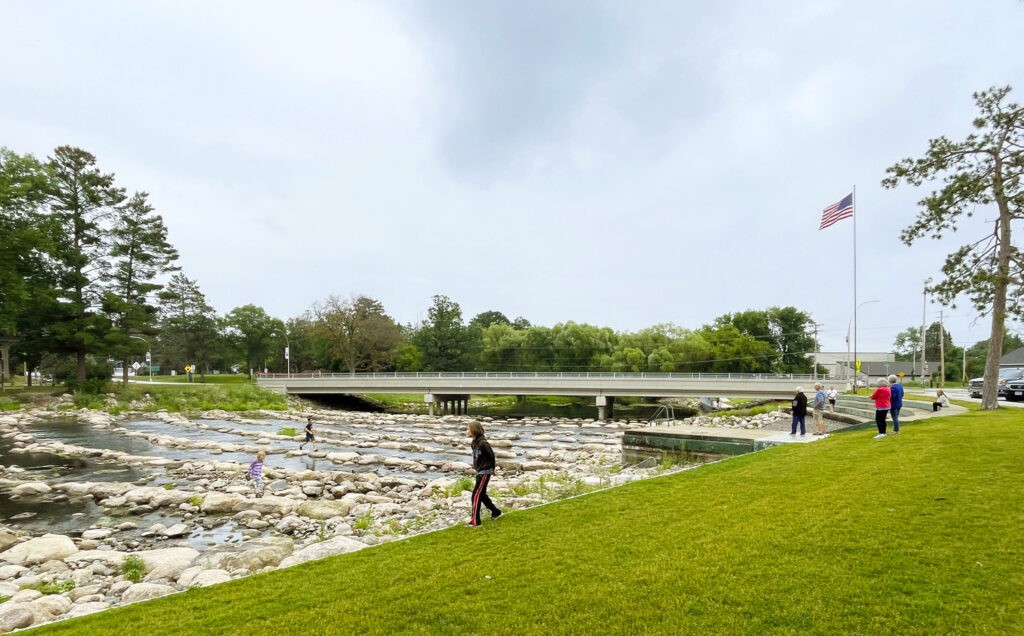
The design team worked with engineers and wildlife specialists to design the gentle rapids.
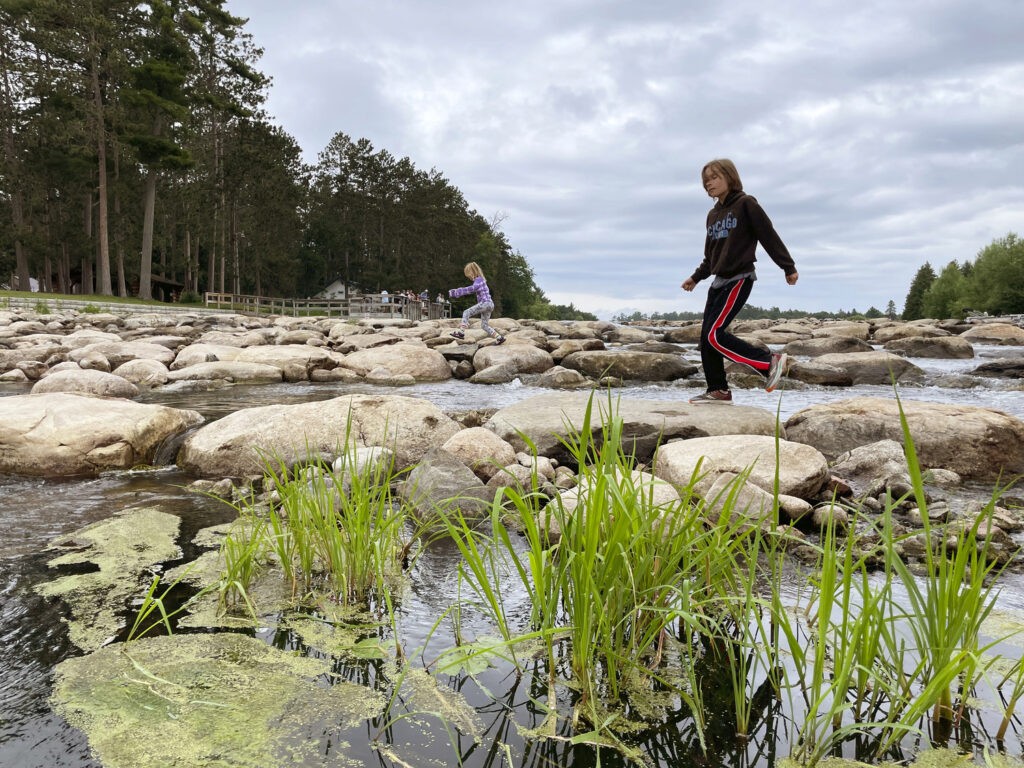
“The biggest challenge was grade change,” Kessel says. Replacing the dam and spillway with the rock riddle meant that water didn’t pool in the same way upstream, lowering the water level in ways that the orphaned the WPA-era steps. A new pebble beach now connects the steps to the water’s edge, but there’s no getting around the fact that the character of the river is altered, says Bryan Drown, an engineer with Bolton & Menk. “It’s a big change in a community that size,” he says. The transformation hasn’t stopped there. The project has since spurred additional public improvements along the river, including a new beach, a pavilion, and a larger play area – though the rapids are themselves a playground as well, Hansen says: “We’ve had more people on a daily basis than I ever thought would be down here.”
The existing dam was beloved as a fishing spot but posed safety concerns.
The project has created better access to the river for anglers and others.